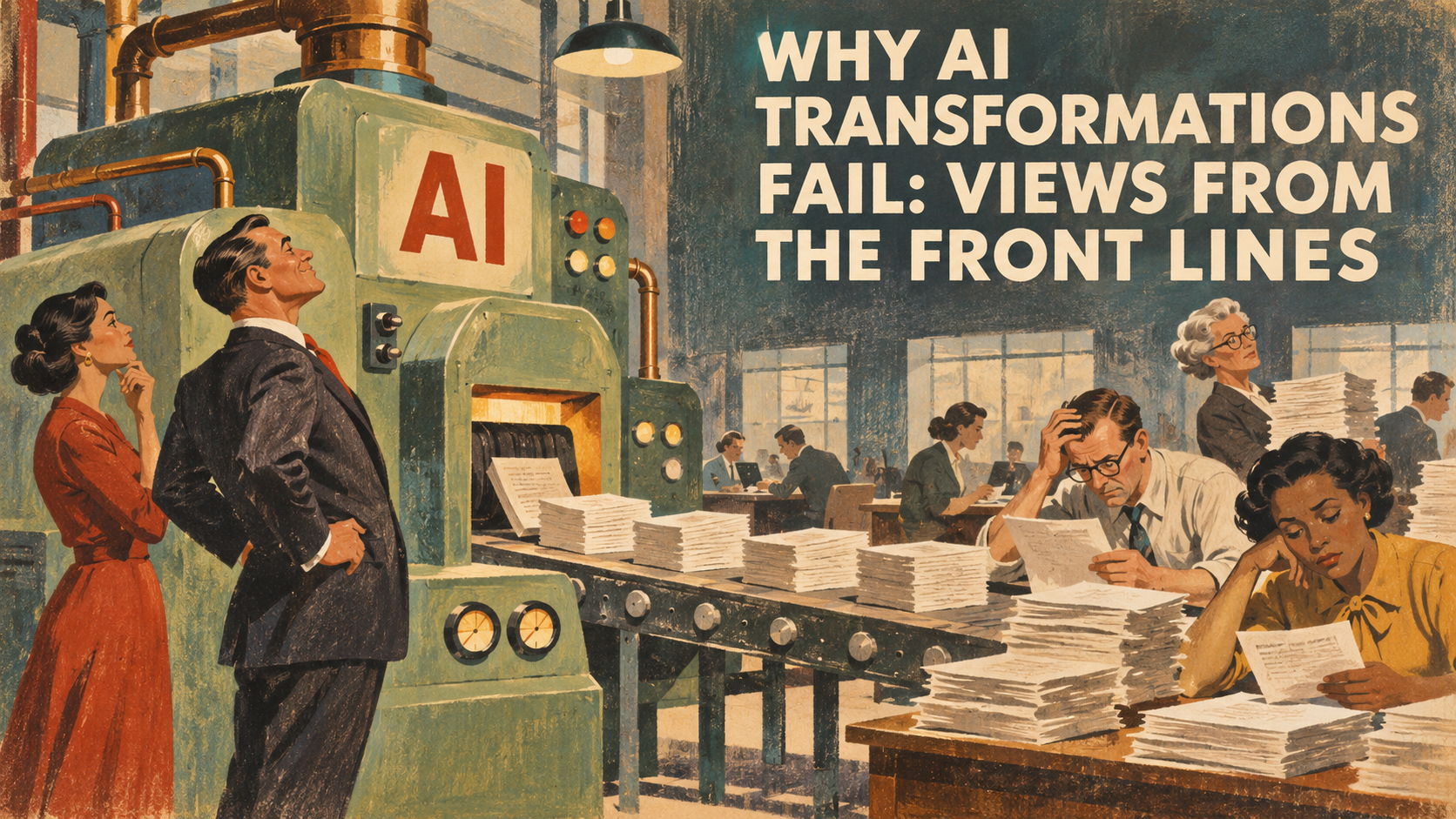
Notes from the steering committee, where good intentions go to be minuted.
Your company has discovered AI.
You may have noticed this from the email. It arrived on a Tuesday, from someone whose job title contains the word "Transformation", and it said AI would "free you up for higher-value work". This is a lovely sentence. It assumes the company has some higher-value work lying about, and that someone knows where it is kept.
Nobody does. A working group has been formed to find it. The working group meets fortnightly and has so far produced a charter, a Teams channel and a logo.
Meanwhile the money has been leaving the building at a respectable clip. BCG reckons companies roughly doubled their AI spending between late 2025 and this year, to about 3.3% of revenue (BCG). About half of them say they are now getting something back. The other half are in the position of someone who has bought a very expensive gym membership and is waiting for it to start working.
MIT's Project NANDA went further and claimed 95% of organisations were seeing no measurable return from generative AI at all (Computing). Several academics pointed out, reasonably, that the method had a few holes in it (BankInfoSecurity). None of them suggested the real number was 6%.
I spend a fair amount of my working life in the rooms where these programmes are designed, and where they quietly die. The models are usually fine. The trouble is what organisations do around them, which tends to follow one of six well-worn paths.
It gets handed to IT
The first thing that happens to AI in most companies is that it is given to the people who run the technology, on the reasonable grounds that it is technology. By the same logic you would hand a new restaurant to whoever installed the ovens, and then be faintly surprised when the menu turned out to be mostly about ovens.
What AI changes is who does the work and what people are paid to be good at, which is a question for the people who run the business. Governance hasn't caught up. In a BCG survey of 152 CEOs this year, more than half said redesigning roles was a major obstacle, yet only 30% had let HR anywhere near AI governance. Technology had a seat at 82% of the tables (BCG).
Over 80% of AI spending now happens outside the IT budget. The money has clearly worked out where the action is, even if leadership hasn't.
I should declare an interest. I'm a technologist, and I can talk about model benchmarks until people start checking their phones under the table. It's the most enjoyable conversation in the building, which is how you know it's the wrong one to start with.
Nobody decided what success looked like
Ask how "the AI programme" is going and someone will show you a chart of logins. It will be heading up and to the right, and everyone will feel briefly reassured, in the way a shopkeeper might feel reassured that lots of people have walked into the shop without any of them buying anything.
BCG found more than half of CEOs see the link between AI and the profit and loss account as a major barrier. Only 14% have actually written down what P&L impact they expect from all their AI initiatives. The others are presumably hoping it will become obvious.
It won't. Somebody has to pick the number they want to move, whether that's cost per claim or days to turn around a quote, measure it before anything is switched on, and get the CFO to agree the maths holds up. This is about as glamorous as going to the dentist, and roughly as widely practised.
The AI strategy has never met the actual strategy
Most companies now have two strategies. One explains where the business is going. The other explains which software it has bought. They are kept in separate decks by separate people, and the closest they come to meeting is being presented on the same day of the offsite, on either side of lunch.
Nearly two-thirds of CEOs in the BCG survey said they were running AI pilots. About a quarter had tied AI into any wider change to how the business runs.
Real strategy means choosing between two answers that are both perfectly sensible, such as chasing growth or protecting margin. AI should be pointed at whichever one you chose. More often it gets pointed at whatever made the room go "ooh" during the vendor demo, which is how a perfectly respectable bank ends up owning an extremely good AI tool for writing poems about its mortgage process.
A pilot in every department
AI makes it nearly free to start things, and organisations have responded with the enthusiasm of my cat when she has just discovered the pantry door was never actually locked.
Every function now has a pilot. There is an AI centre of excellence, which is excellent mainly at booking demos, and a spreadsheet of use cases long enough that nobody has scrolled to the bottom since March. MIT's researchers found the largest companies ran the most pilots and got the fewest into production.
Our advice is to choose a few areas that matter and fund them properly for several years. That would mean shutting down most of the spreadsheet. No centre of excellence in recorded history has voluntarily shut down anything.
Everyone gets a chatbot
Sooner or later somebody proposes giving the whole company a chat assistant. This is a semi-sensible thing to do, provided nobody then announces that the transformation is complete.
A chat assistant makes each person a bit quicker at whatever they were already doing. The business case assumes the saved minutes will be gathered up and spent on higher-value work, wherever the working group eventually finds it. In practice they get spent on slightly longer emails, noticeably better-formatted slides and a new meeting to review the slides.
In our view, deploying chat AI on its own usually delivers zero to negative ROI. Saved minutes only turn into money when someone redesigns the work so the capacity goes somewhere useful, or the cost actually goes away. BCG found the companies doing well were about seven times more likely to have redesigned whole workflows. We agree.
AI is pushing the price of expertise towards zero. I even wrote a book about it. If your business buys expertise, happy days. If it sells expertise, you may want to sit down and take a deep breath. The companies coming out ahead let the machines handle the expertise and keep their people for the judgement calls, which is where the accountability lives anyway. This is harder than it sounds. For a start, it assumes you know what good judgement looks like and, more importantly, that you measure the quality of decisions.
The CTO is put in charge
Eventually the whole thing is formally handed to the CTO, who is very good at technology and therefore precisely the wrong person to own it alone. The decisions that determine whether AI pays off are about pricing, roles, risk and how the company makes its money. They belong to the CEO, with the CFO and the head of people in the room and the CTO keeping the platform upright.
BCG's recommendation is that the CEO act as "orchestrator", which is management consultant speak for "it's your job".
There is also the awkward matter of who carries the can. AI suffers no consequences. I am still waiting for the first CEO to tell their board that the AI told them to do it. I expect the meeting will be short, and the one after it, about CEO succession, slightly longer.
Where it all ends up
Put these together and companies tend to settle into one of three conditions. BCG's 2025 numbers give a rough sense of the proportions: 14% doing little or nothing, 46% experimenting without getting anywhere much, and 5% making real money from it (BCG).
The first condition is paralysis. Legal has concerns, the risk register has reached the length of a short novel, and the board would like a policy before anyone touches anything. Nothing ships, which feels safe because doing nothing never appears as a line item. It shows up later, all at once, when a competitor halves its cost to serve.
The second is the chatbot company. Copilot licences went out a year ago, usage looks healthy, and the CFO has just asked where the money went. Everyone has become very interested in the quality and length of their new AI-generated emails.
The third is frantic activity: dozens of pilots, a demo every fortnight and a board report so green it could photosynthesise, right up until someone asks which of the pilots is live and delivering ROI.
They look different from the outside. Underneath, all three bought AI as a tech product, when what they needed was to change how the work gets done.
What the others do
The companies getting a return aren't doing anything mystical, which is a disappointment to everyone selling mysticism. They decide what business result they want before they go shopping for tools. They pick a small number of workflows and rebuild them properly. They agree the baseline with finance and report on results instead of logins.
They also think hard about how their people will keep learning now that the junior work is being done by something that doesn't need a mentor. And the CEO owns it, with their name on it.
The dark horse in a lot of successful AI transformations is the Chief People Officer. Why would you put a technology project in the hands of the people person? Well, funnily enough, human beings are funny creatures. We hate change, and if you haven't been keeping up with current events, we still do most of the work. That means a successful AI transformation is about working out what work humans will do, and what work will be automated. I can tell you from first-hand experience the latter is the easy part. If you are going to be successful with AI, your People Leader needs to be a central part of the process.
If you'd like to know which group you're in, ask three questions at your next executive meeting. What is all this spend supposed to change, and by how much? Which pieces of work have we actually redesigned, as opposed to sticking a tool on top of? And whose problem is it if the return doesn't turn up? If the room turns, as one, to look at the CTO, you have your answer.
Buying the technology was the easy bit. The harder bit is deciding what your people should spend their days on once the agents are doing the rest. In a lot of companies that decision is still sitting in the CEO's in-tray, somewhere underneath the latest invoice from Microsoft.
If you haven’t been keeping up with current events, the next wave of digital disruption is upon us in the form of artificial intelligence (AI). For experienced leaders who’ve already weathered the disruptive impacts of Web 2.0, e-commerce and mobile technology, this may feel like yet another industry trend we need to come to terms with. But the truth is, artificial intelligence is a seismic shift that will completely transform how we both work and live.
From healthcare to transportation, AI will empower us to make more informed decisions at an unprecedented scale. If you’d asked us two years ago which sectors wouldn’t be severely impacted by AI, we would’ve mentioned STEM, the creative arts and empathy-based healthcare. Yet, in the past six months, we’ve seen all three experience the powerful effects of AI. On the surface, AI promises greater productivity, streamlined processes and limitless innovation. But this promise comes with caveats, as concerns emerge about potential job displacement, compelling organisations to adapt their structures and strategies. This article delves into the layers of AI’s impact in the workplace, exploring its influence on knowledge workers, organisational design and the pivotal role of the C-suite.
The AI-Driven Shift: A Complicated Transition
While AI’s transformative potential is undeniable, it brings with it many complexities that greatly impact the workforce. On the one hand, AI presents an enticing prospect of automation, alleviating the burden of mundane tasks and enabling employees to concentrate on high-value, strategic work. On the other hand, these advancements also give rise to real concerns about job displacement and the widening skills gap as the demand for AI expertise skyrockets. And the question of whether the number of new jobs AI creates will surpass those lost remains to be seen.
Beyond the individual level, organisations are grappling with the AI revolution, often finding themselves ill-prepared to navigate this transition. A lack of readiness, caused by either underestimating the reach of AI or struggling to keep pace with its rapid evolution, means a strategic re-evaluation among those in leadership positions is needed. We saw this denial during the previous wave of digital disruption, resulting in unprepared incumbent players displaced by new, more agile organisations that embraced or embodied the emerging technology.
Adding to the intricacies of this transition, governance, regulation and ethics present further challenges. As AI continues to permeate business operations, concerns about privacy, data security and ethical use of AI have taken centre stage, and regulators are scrambling to keep up. Many governments around the world are still struggling to grasp the very concept of TikTok, let alone comprehend the complexities of the impact of AI on the workplace and society. On the flipside, though, corporations find themselves in a unique position to self-govern, developing robust ethical frameworks that will guide their AI implementations now and into the future. C-suite executives, then, have an extraordinary opportunity to drive AI strategy and ensure it aligns with emerging regulations and ethical standards.
Navigating the Impact of AI: The Burning Question
Amidst these formidable challenges, a pivotal question arises: “How can C-suite executives effectively assess the impact of AI on the workforce?” Addressing this complex puzzle calls for more than a straightforward approach; it needs a comprehensive strategy that brings together the technological finesse of AI with the intricate dynamics of the human workforce.
Scenario Planning: Anticipating the Unknown
In our experience collaborating with clients, we’ve come across a diverse range of perspectives about the impact of AI on the workforce. While some perceive AI as a threat to their businesses, others recognise it as an incredible opportunity. We firmly believe that predicting the future is an impossible task, and it’s also unnecessary. The strategic tool of scenario planning is a much better way to navigate the uncertain terrain of AI transformation. By envisioning various outcomes and preparing suitable responses, organisations can address potential vulnerabilities and seize opportunities, whether by embracing automation or adopting AI-driven business models.
Typically, we develop three to five scenarios for each client, outlining the conditions needed for each to occur. Then we comprehensively assess the positive and negative impacts of each scenario on the business. In formulating responses, we often discover a common subset of actions applicable across all scenarios. The beauty of this approach is that it doesn’t require the ability to predict the future. In fact, these ‘no regret’ actions foster consensus within the executive team, as they establish strategic flexibility regardless of the scenario that ultimately unfolds.
Redesigning the Organisation for AI
In recent years, we’ve witnessed the convergence of strategy and organisation design to the point where they’re now almost indistinguishable. This has also corresponded with an excessive emphasis on talent. While talent is undoubtedly crucial, we firmly believe in the adage that “even a flawed system can outperform the most skilled individual”. As a result, we consider organisational design to be essential for all leaders striving to align their organisations with their strategic objectives. By investing in organisational design, they can create work environments that not only promote the growth and success of their talent but also reduce obstacles along the way, decreasing frustration.
When considering the impact of AI on an organisation, it’s crucial to acknowledge the necessary adjustments to its design. As AI will influence various aspects of organisation design, including ways of working, incentives, talent management and structure, integrating it into daily operations and strategies requires a comprehensive reassessment of capabilities, team dynamics, collaboration and decision-making processes.
To drive performance, leaders must identify any necessary roles and skills and determine the most suitable organisational model for managing operations integrated with AI. It’s also important to consider critical questions: How will decision-making authority be distributed among teams? What roles are required for data collection, analytics and operational execution? How can potential conflicts over resources, data ownership, skills and capabilities be avoided or resolved?
Unveiling these answers will shed light on the distinct challenges and opportunities that AI presents for each organisation. In reality, reshaping an organisation for AI is not a one-time endeavour; it requires an ongoing process of adaptation and evolution. Our approach has always encouraged leaders to treat organisation design like product design – managing ‘release cycles’ of iterative change rather than opting for a drastic overhaul. As AI technologies advance and mature, organisations must continuously adjust and refine their structures, processes and cultures. It’s undeniably a formidable task, but one that can yield substantial rewards for enhanced efficiency, innovation and competitiveness.
The Emergence of the AI Vanguard: Chief AI Officer and Chief Data Officer
As organisations grapple with the complexities of integrating AI, there’s a growing demand for specialised roles to address these challenges. The rise of Chief Data Officers (CDO) and Chief AI Officers (CAIO) within the C-suite reflects this need. The CAIO acts as a strategic compass, ensuring AI aligns with organisational objectives and overseeing implementation across functions. In contrast, the CDO manages data as a strategic asset, ensuring quality, compliance and accessibility for AI initiatives. Together, they lead the charge in navigating the transformation, and driving AI development and deployment.
The specific roles of these executives, however, vary based on company size, maturity level and strategic objectives. Both positions require a deep understanding of data science and AI technologies. Their emergence is driven by the vital role data plays in this transformative process. Data, often called the ‘new oil’, undeniably fuels AI. To be truly prepared, it’s essential that an organisation handles data intelligently. This involves understanding data origin, implementing effective cleaning and storage procedures, and employing efficient analysis methods. Developing robust data management and analytics capabilities is absolutely crucial when preparing for the advent of AI. In an era where many organisations can access sophisticated AI models, proprietary data sets have become a critical competitive differentiator and they are vitally important in this landscape.
In many respects, the positions of CDO and CAIO represent a convergence of traditional Clevel roles. They combine knowledge usually held by executives from IT, operations, analytics and finance. By creating these specialised positions within their executive teams, organisations can reap the rewards of AI while managing potential risks. This also allows companies to drive innovation and gain a competitive edge in the rapidly changing technological landscape.
The advent of the Chief AI Officer (CAIO) and Chief Data Officer (CDO) roles significantly impacts the role of the traditional Chief Information Officer (CIO). While the CIO has historically managed data and technology, the introduction of CAIO and CDO roles brings a more nuanced division of responsibilities. We expect the CIO will continue to oversee the technological infrastructure of the organisation, ensuring its strategic alignment with business goals. Meanwhile, the CAIO will focus on embedding AI technologies into business operations and the CDO will primarily manage data governance and strategy. Together, the CIO, CDO and CAIO form a triumvirate working in unison towards a common goal: leveraging data and AI to drive innovation, efficiency, and strategic advantage. This collaboration requires clearly defined roles and open communication channels to ensure seamless operational and strategic integration.
Charting the Future: Embracing AI Transformation in the C-Suite
The potential of AI in the business world is significant, but its realisation ultimately depends on the C-suite. As the decision-making core of any organisation, the C-suite has the power to drive AI adoption and integration. As a C-suite executive, you’re responsible for developing and executing AI strategy, aligning AI applications with business objectives, and cultivating an AI-ready workforce. These crucial components require the executive team’s vision, commitment and leadership. It’s your role to champion the cause, overcome resistance and propel the organisation into the AI age.
But for AI transformation to truly succeed, it requires more than just technological upgrades and talent acquisition. A fundamental redesign of an organisation is needed – one that remodels its structure and processes, morphing it into an environment that supports AI. Shaping the organisation’s design is a powerful tool for the C-suite. By ensuring that the design aligns with strategic goals, leaders can encourage a culture of innovation and agility – principles essential for navigating the dynamic AI landscape of the future. So, while the road to AI maturity may have its challenges, the rewards it promises undeniably make the journey worthwhile. The future is here… and it’s time for the C-suite to take action!
Humanly Agile is business design practice that helps senior executives bridge the gap between strategy design and execution. We create organisation designs that enhance agility, and human-centred change programs that accelerate transformation.
Jamie Pride is the Managing Partner of Humanly Agile and a recognised authority on organisation design. He has worked with many Fortune 500 companies to help them develop strategies, structures and cultures which are ready for the AI revolution. With over 25 years’ experience in strategy design, culture change and leadership development, Jamie helps organisations succeed in the era of disruptive technology.
Peter Ryan is an Executive Advisor with Humanly Agile and has over 30 years of Big 4 experience in technology advisory, implementation and managed services delivery in Australia, Asia, USA and UK. His work has focused on defining technology strategy, designing pragmatic operating models and implementing complex advanced technology enabled solutions across multiple industries.